What Gets in the Way. And What Gets You Through.
Haven’t read Part 1 yet? Start here.
In the last post I shared Chris’ words along with a couple of stories from my own week and how I related to what she said.
If you missed it, here is what she said:
I was just thinking this morning. If I only had someone to push me, but then I thought, I shouldn’t need to have someone to push me. But I do, it’s just me.
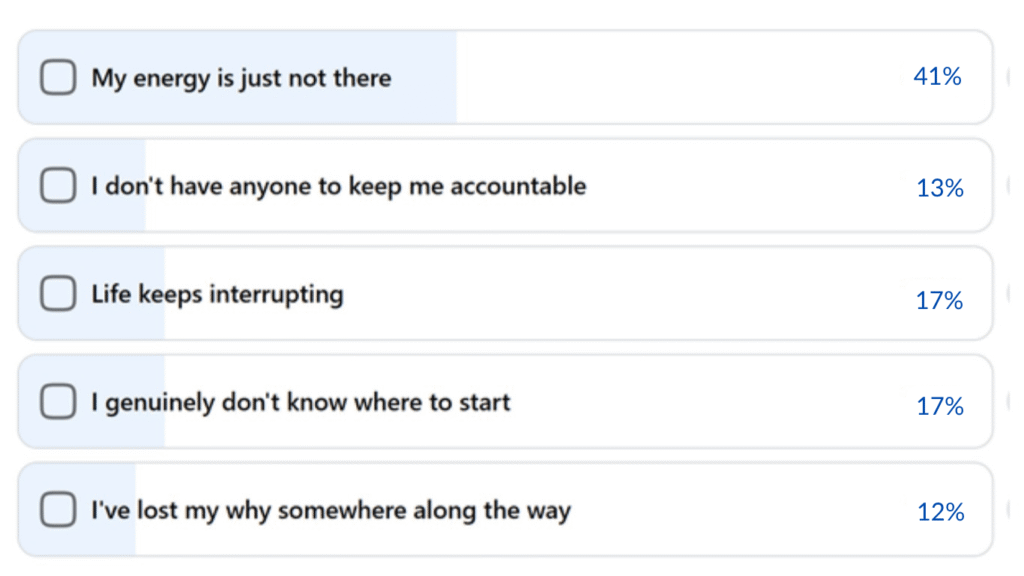
Here’s how this came about. We ran a poll in the group asking what gets in the way of moving consistently. There were five answers to choose from, based on what women tell us about their biggest obstacles.
Here’s my thoughts on each one — and a little of what the research shows.
My energy is just not there — 41%
This was the biggest one. And it makes sense, because the changes that happened during menopause impact energy. Hormonal changes, disrupted sleep, the weight of everything we carry — it’s not in your head. Your body and your responses changed.
But here’s what I know. Energy makes energy. Waiting until you feel ready will not create more energy. Moving is what creates it. I’m not talking the ideal workout or massive, long session. It’s about moving. Five minutes. A walk up and down the hallway. Even simply standing instead of sitting.
The research backs this up. One study found that sedentary people who did regular low-intensity exercise reduced their fatigue by 65% in just six weeks. Not hard sessions. Low intensity. Energy makes energy — and the science agrees.
The energy that gets you through comes from the movement itself. Not before it.
And I get it. If you are super tired, the last thing you want to do is more. So here are a few things that can help restore your energy alongside movement:
- Get outside for even ten minutes. The combination of light and movement does something indoor exercise doesn’t quite replicate.
- Get your feet on the ground or some sun on your face. Simple. Effective.
- A glass of water first thing. Dehydration is one of the most common and overlooked causes of fatigue at this life stage.
- A catnap — not a long one. Just enough to take the edge off.
- Look at what you’re eating around movement. Protein matters more than most of us realise for energy.
- Magnesium. It affects energy and sleep quality and for many women post-menopause it’s worth considering.
Life keeps interrupting — 17%
Hey, life happens and this is never going to change. We plan for the good times — travel, retirement, weddings, grandchildren — and forget the rest. What matters is whether you have a plan for when life does interrupt your routine.
I get this one personally. Recently my routine completely fell apart — not because I let it, but because life demanded it. The stress was through the roof. And what I had was a plan. Not a perfect one. Just the knowledge that when everything goes sideways, here is the smallest thing I can do. Here is what I come back to.
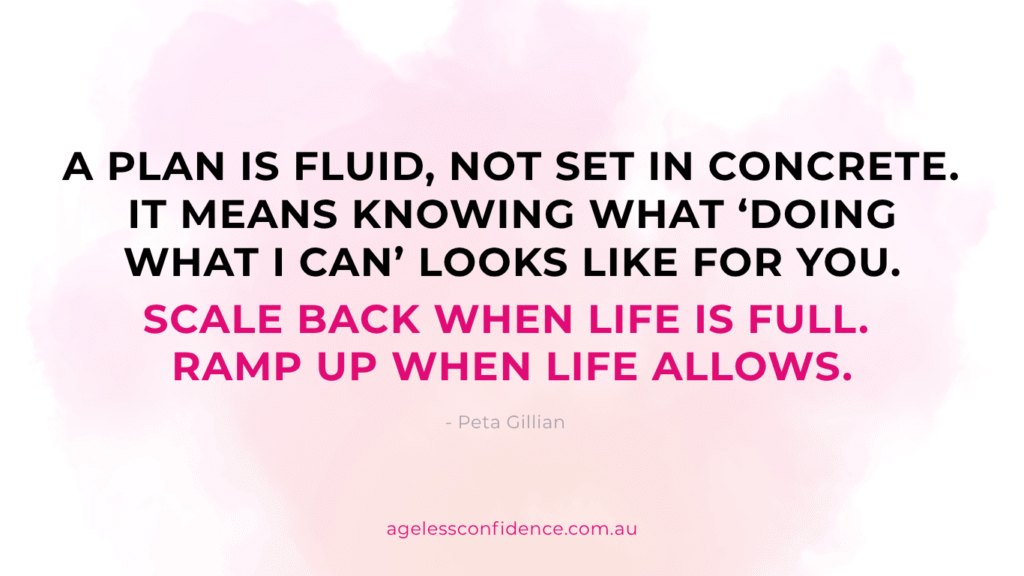
The key is having a routine that scales up or down depending on what is happening in your life. My Ageing with Intention guide can help you work out what is important to stay strong and capable — and from that, what your scaled-back version looks like when life is demanding, and what your fuller version looks like when life allows.
Take strength training as an example. That same session can take an hour when life is cruisy and ten minutes when that is all you have. You don’t stop. You adjust. And knowing in advance what ‘doing what I can’ looks like for you means that when life hits, you already have the answer.
I genuinely don’t know where to start — 17%
I want to say something about this one. Saying it out loud — I don’t know where to start — takes some serious grunt. And guess what? You just started by being involved and acknowledging it.
Next step: ask yourself what you are noticing in your body right now. What feels tight, heavy, slow? What do you wish you could do that you’re not doing?
Then: what is one small thing you could do today? Or even right now.
- Get up and walk up and down the hallway.
- Boil some eggs, so you have protein ready to go.
- Take five and do some stretching in bed before you get out. Bonus: a perfect energy boost.
- Sit to stands from your chair.
- Kitchen bench push-ups.
- Lunge to the mailbox.
You are looking for something that connects you back to your body. Starting is the hardest part. Once you’ve started, the next step is to do it again tomorrow. Maybe you do one minute of something every time you go to the bathroom — that adds up fast. Then commit to seven days and build your winning streak.
I don’t have anyone to keep me accountable — 13%
Here’s the truth about accountability. Most people don’t stay with a coach forever. They start. They learn. They get supported through the early part. And then they understand how to do it themselves.
That’s the goal. Not dependence. Understanding.
In my book I talk about three key ingredients. The first is your past — what has got you moving before, and what has held you there. We are all movers. Every single one of us has moved at some point in our lives. Your past tells you something important about what works for you.
The second is your future — take a look ahead and decide what you want that to look like. Use your family history as a guide — their story doesn’t have to be yours. Let your future, and how you see it, be what guides you.
The third is your present. Each day is about choices and the daily actions you take. They don’t have to be big. Small, consistent actions add up. You make these choices because you are important to you. And that is reason enough.
And sometimes posting what you’ve achieved on social media can feel like you have someone taking the steps with you. You are acknowledging you.
I’ve lost my why somewhere along the way — 12%
The why lives in the future. When you’ve lost it, it usually means you’ve stopped looking ahead.
So look ahead. Not at who you used to be or what you used to do. At what you want the next chapter to look like. What do you want to be able to do? Who do you want to keep up with? What does moving well make possible for you?
Get down and dirty with this one. It scares the living daylights out of me to think about living a life like the women in my family. Obese, unable to move freely and easily, needing help, on so many medications you rattle when you walk because of the chronic illnesses.
What don’t you want to be? Most of us can work that out a lot easier than what we do want. Start there. That’s your why.
Age with Intention or Age by Default
Here’s what it comes down to.
You can age with intention — making choices, even imperfect ones, that keep you moving, capable and in your life. Or you can age by default — letting it happen to you, waiting until you feel ready, hoping the energy shows up on its own.
It won’t. But you already know that.
You’re here. You read this far. That tells me something about you.
The Confidence Connection
Here’s what I know about confidence. It doesn’t arrive before you start. It shows up after. A bit like motivation — it never shows up until you start. Not all at once. Gradually, quietly, in the moments where you realise you did it again. You showed up again. And slowly that becomes who you are.
I spent my younger years feeling invisible. I know what that does to you. What I’ve learned — the hard way, over a long time — is that nobody else gets to hand you that confidence. You build it by doing. Consistently. In whatever form that takes for you. And one day you look up and realise — I’m doing this. I’m actually doing this.
That’s what consistent movement does. Not just to your body. To your belief in yourself.
Move Moment
This week, find one thing from your past that got you moving — and do it.
P.S. Which one of those five poll answers is yours right now? Tell me in the comments — and let’s work it out together.