Losing It Is Fast. Getting It Back Isn't.
How Long Does It Actually Take?
Here’s what my clients keep asking me: “How long until I get back to where I was?”
And I get it. Because I’m asking myself the same question right now.
Eight weeks out of action – fracture, then viruses – and I’m four weeks into my rebuild. I’ve lost fitness, strength, balance, and the ability to get up and down easily. And like everyone else, I want it back instantly.
But here’s the thing about losing and regaining – it never works the way we want it to.
The Weight Loss Parallel
Think about weight gain. You put it on slow and steady. A bit here, a bit there. You hardly notice it happening. Until one day you do, and suddenly you want it off immediately. You forget it took months or years to accumulate. You just want it gone now.
Fitness loss is the same pattern, except compressed. You build strength slowly over months. Then life happens – injury, illness, whatever stops you from training – and within weeks, it’s disappearing faster than you built it.
And when you’re ready to rebuild? Your brain expects it to come back instantly. Like flipping a switch.
It doesn’t work that way.
What The Research Actually Shows
The research calls me a “senior” or “older adult” now. I’m in my 60s, so technically I’m in their studies. But here’s the thing – I was climbing trees with my grandkids before the fracture, and I fully intend to get back to it.
The research is helpful for understanding what’s happening in my body. It’s not helpful for defining what I’m capable of.
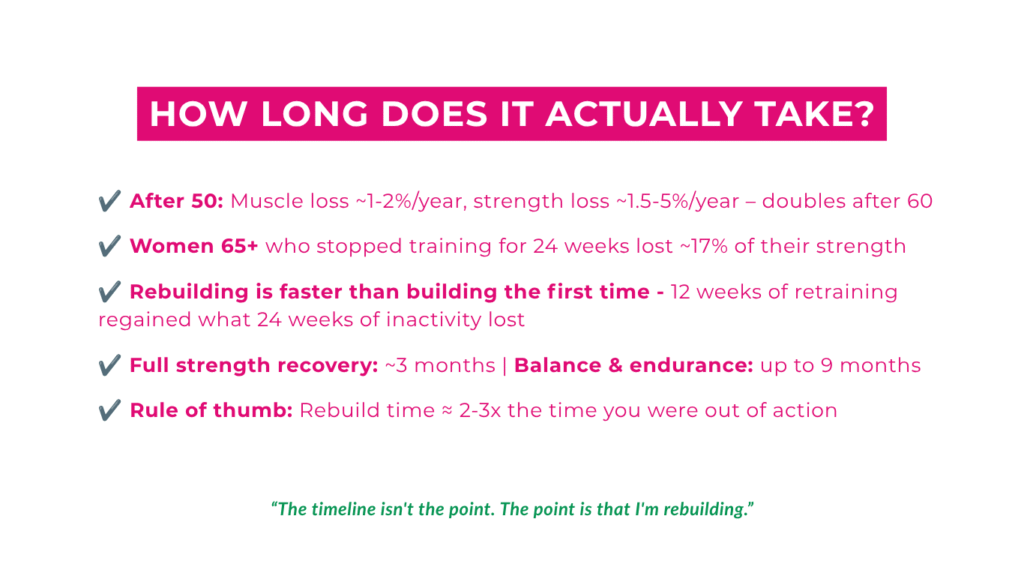
Here’s what the studies show for women our age: After 50, we lose muscle mass at about 1-2% per year and strength at 1.5-5% per year just from ageing. That rate doubles after 60. Add in complete inactivity – like being stuck in bed with viruses for weeks – and that rate accelerates dramatically.
And here’s something else the research shows: power declines faster than strength – about 3.5% per year compared to 1-2% for strength. Power is that explosive ability to move quickly – getting up from a chair fast, catching yourself from a fall, jumping up onto something. It impacts daily life more than pure strength does because most of life requires quick reactions, not just maximum force.
In one study, women over 65 who stopped training for 24 weeks lost about 17% of their strength. My eight weeks of forced inactivity? The loss was real and it was fast.
What I Actually Lost
I got smaller. Lighter on the scales. And completely unable to do daily life well.
This didn’t surprise me – I know the physiology. But seeing it in my own body was different. I could feel the weakness. The breathlessness. The effort it took to do simple things.
Four weeks into my rebuild, I’m seeing progress. Some muscle definition coming back. Not so out of breath. Walking quicker. Everything in general improving.
But it’s slower than I want. And that’s the bit I had to accept.

The Confidence Connection
Losing what you could do knocks your confidence around, not just your body. And once it’s knocked, it’s hard to get back on top of it – same as the fitness. You don’t just doubt what you can lift or how far you can walk. You start doubting yourself. That confidence takes as long to rebuild as anything else does. Maybe longer.
The Good News: Muscle Memory
Here’s what the research shows about rebuilding for women over 50: it’s faster than building it the first time.
In studies with women aged 65-84, after 24 weeks of not training, they lost about 17% of their strength. But here’s the good bit – 12 weeks of retraining was enough to regain what they’d lost. Half the time. That’s muscle memory at work.
Your muscles remember. Even when you can’t see it or feel it, the changes you made are still there at a cellular level. When you start training again, your body responds faster than it did the first time.
But – and this is important – faster doesn’t mean instant.
My Actual Rebuild Plan
I’m prioritising strength first because it supports daily life. That’s what matters most to me. But it’s not just about lifting weights – I’m training for power too. That explosive ability to move quickly matters more for daily life than pure strength does.
Here’s what I’m actually doing:
Week 1: 10-minute strength sessions, 15-minute or there about walks
Week 2: Two 10-minute strength sessions, building on my walking time
Week 3: Two 20-minute strength sessions, continue walking and increasing pace
Week 4: Two 30-minute strength sessions, plus other bits and pieces
Week 5-6: Three or four 30-minute strength sessions, plus other bits and pieces
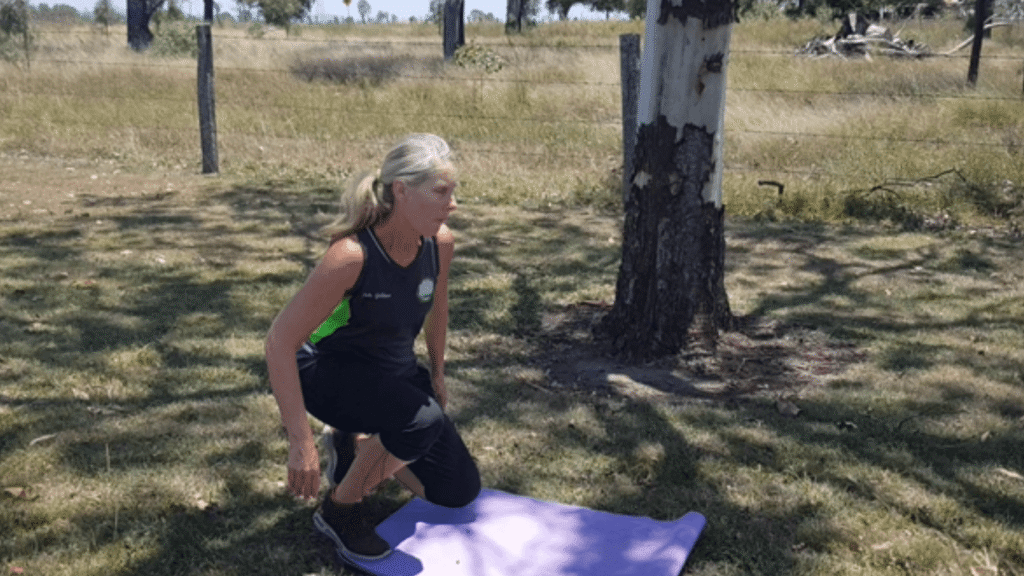
As it feels right, I’ll add back the things that test my power and function: hanging from the swing, step-ups building to jumping, getting up and down from the floor and increasing the speed. Balance training. Mobility work.
It’s methodical. It’s progressive. And some days it feels painfully slow.
The Permission You Need (That I’m Giving Myself)
Here’s what I’m learning as I rebuild:
You can’t rush this. Not because you’re incapable. Not because age has made you fragile. But because your body needs time to adapt.
The research shows it takes about 3 months to regain strength fully. For aerobic endurance and dynamic balance, it can take longer – up to 9 months.
That’s longer than anyone wants to hear. Including me.
But the alternative? Pushing too hard, too fast, and ending up injured or burnt out. Then you’re starting over again from an even worse position.
I’m four weeks in. I’m seeing progress. And I’m reminding myself daily that the timeline isn’t the point. The point is that I’m rebuilding. That my body is responding. That I will get back to climbing trees with my grandkids. I’m already hanging from the swing and doing 1 pull up, as well as jumping, so I’ll be there before I know it.
Just not today. And not on the timeline my impatient brain wants.
What This Means For You
If you’re restarting after illness or injury or just life getting in the way:
The loss is real. The research is clear on that. After 50, we lose it faster. During complete inactivity, we lose it even faster than that.
But the rebuild is also real. Muscle memory means you’ll regain it faster than you built it originally. Your body remembers what it could do, even when you can’t feel it right now.
It’s going to take longer than you want. Probably 2-3 times longer than the time you were out of action. For me, that’s 16-24 weeks to get back to where I was before the fracture.
That’s not what I want to hear either. But it’s honest.
And honestly? I’d rather know the realistic timeline and work with it than expect instant results and feel like a failure when they don’t happen.
And of course, there is always hope that it will be quicker because of the baseline that I originally started with.

Move Moment
Now it’s your turn. Pick one simple action – just one – and do it. That’s all it takes to get started.

PS – can you believe that time off your training plan because of illness or injury can take 2-3x as long to rebuild? And it's not just being unwell. Any time off does it. Here's the breakdown.