Follow the Leader — and I Did. This Is What I Train For
We were walking to the jetty along the Redcliffe foreshore when the eldest spotted it.
A garden retaining wall — about sixty centimetres high, running alongside the path with plants spilling over the top. Without a word, he stepped up and started walking it. Arms out, one foot in front of the other, balanced and steady.
Then the next one did it. Then the next.
By the time the youngest — nine years old — stepped up and walked the whole thing without hesitating, I was watching with a different kind of attention.
What a brilliant single-leg stability exercise. Right there. On the foreshore. For free.
And then, almost in the same breath: Can I do this?
Followed immediately by: You won’t know unless you try.
So I did. I walked the whole wall, just as they had. I had a big smile on my face by the time I got to the end — and I jumped off exactly the way the kiddos did.
What’s Really Happening
Walking a narrow surface isn’t just a childhood game. It’s a legitimate test of single-leg stability, lateral balance, proprioception, and the ability to control your body through a movement pattern that most of us perform dozens of times a day without ever thinking about it.
Every time you step off a kerb, climb out of a car, navigate uneven ground, step over something on the floor, or take the stairs without holding the railing — you’re relying on exactly this. Single-leg control. The ability to load one side of your body, stabilise through it, and move with confidence.
When that capacity is strong, you don’t think twice. You just do it.
When it starts to erode — quietly, gradually, often without notice — you start making small adjustments. You reach for the rail. You slow right down on uneven ground. You sit to put your shoes on. You avoid the kerb that’s a bit high.
None of these feel like a big deal in the moment. Collectively, they tell you something important.
Real-Life Anchor
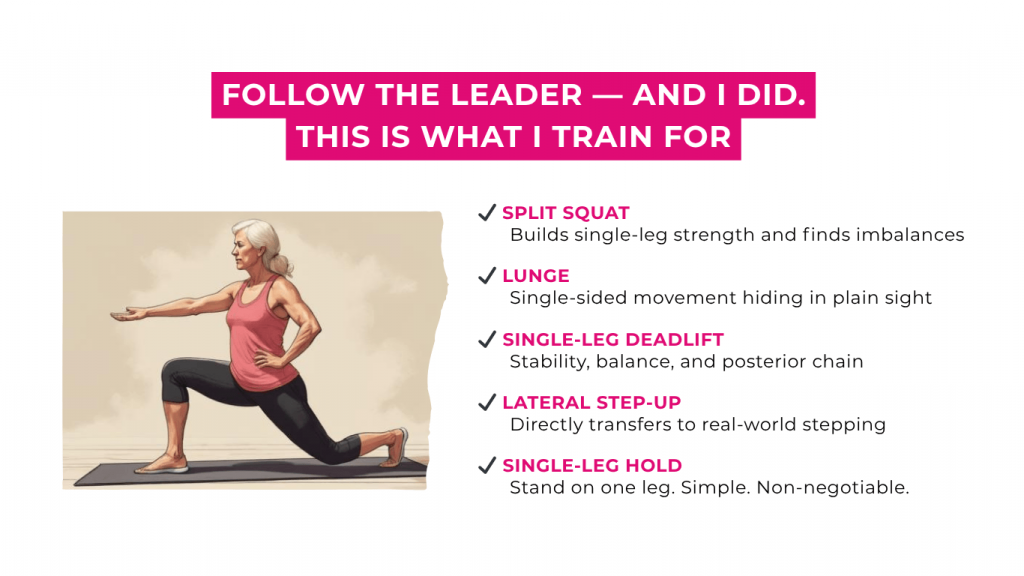
This is why unilateral training — single-sided work — is a non-negotiable in how I programme for my clients and for myself.
A deadlift works both sides. A squat works both sides. But a split squat, a lunge, a single-leg deadlift — these tell you something a bilateral movement never will. They find the imbalances. The side that wobbles. The hip that dips. The ankle that compensates. The weakness that the stronger side has been quietly covering for.
You can’t hide it when you’re standing on one leg.
And here’s what I know from twenty-plus years of working with women: those imbalances don’t stay hidden forever. Eventually they show up as a knee that grumbles, a hip that tightens, an ankle that gives way on uneven ground. The single-leg work doesn’t just build strength — it finds the gaps before they become problems.
I train this way because in my mid sixties, I’m still walking retaining walls with my grandkids. And I want my clients to be doing the same.
The Shift
I wasn’t surprised I could do it. But I was curious — and that curiosity matters.
I knew I should be able to do it because I do the work. The split squats, the lunges, the single-leg movements in training sessions. I put it in because I know what it builds. The retaining wall was just a real-world receipt.
And the opportunities to practise are everywhere, if you look for them. We do it every week — walking the yellow line along the footpath at the shopping centre. It sounds simple. It is simple. That’s the point. You don’t need a gym to practise single-leg balance. You just need to pay attention to what’s already in front of you.
That’s the thing about functional training — you don’t always see the return immediately. You see it when a nine-year-old steps off a garden wall and you think can I? and the answer is yes.
The point of training isn’t to get better at training. It’s to get better at living. Stepping up, stepping over, stepping off. Moving through the world with confidence rather than caution.
The Confidence Connection
There’s something specific that happens when you try something — really try it, not just think about it — and find out you can.
It’s not arrogance. It’s evidence.
I wasn’t hoping I could walk that wall. I tested it. And the test came back positive. That’s a different kind of confidence to anything you can talk yourself into. It’s physical proof that your body is still capable, still responsive, still worth investing in.
This is what unilateral training quietly builds. Not just strength — trust. Trust in your body to handle whatever the day puts in front of you. A step up. A narrow path. An uneven surface. A garden wall along the Redcliffe foreshore.
You won’t know unless you try. But you’re far more likely to try when you’ve been doing the work.

Move Moment
Find a step — a kerb, a single stair, a garden edge.
Stand beside it. Step up onto it with one foot. Hold for three seconds. Step back down. Repeat on the other side.
Do five on each. Notice if one side feels steadier than the other. That’s information.
That’s also the beginning of the work.

PS. The five movements that mean you can say yes when it counts.