Staying In It: The Willingness to Keep Going — and Asking for Help
I recently finished Rob Lowe’s memoir Stories I Only Tell My Friends, and one moment has stayed with me.
He auditioned on crutches.
Coming off an injury that could have been the perfect excuse to sit out, he showed up anyway.
Not because the circumstances were ideal.
Not because it was comfortable.
But because he chose not to withdraw.
The willingness to keep going when it would be easier to stop.
What Resilience Actually Looks Like
The memoir isn’t a highlight reel. It’s the story of someone who:
• Had his career nearly derailed
• Struggled with addiction and rebuilt his life
• Faced setbacks he couldn’t control
• Kept showing up anyway, step by step
There’s a quote in the book that struck me:
“If you can’t get honest with yourself, if you can’t look yourself in the mirror… you are literally putting your life at risk.”
Resilience begins with honesty.
You can’t keep going if you won’t face where you actually are.
Lowe describes his approach as “following his heart and staying out of the results.” That isn’t blind optimism. It’s an understanding that you control effort, not outcome.
Show up.
Do the work.
Let go of what isn’t yours to control.
That’s resilience.
Reading that, I realised resilience rarely looks dramatic in real life.
Reading that made me think about 2025.
It was one of the fullest years I can remember. Paul in hospital. Mum unwell and then fracturing her face, and in and out of hospital. The grandkids living with us. I got sick. Then I managed a fracture on the ski fields, curtesy of a young girl who couldn’t control how she stopped. Apparently, I was it.
There were days I felt like I was coming undone.
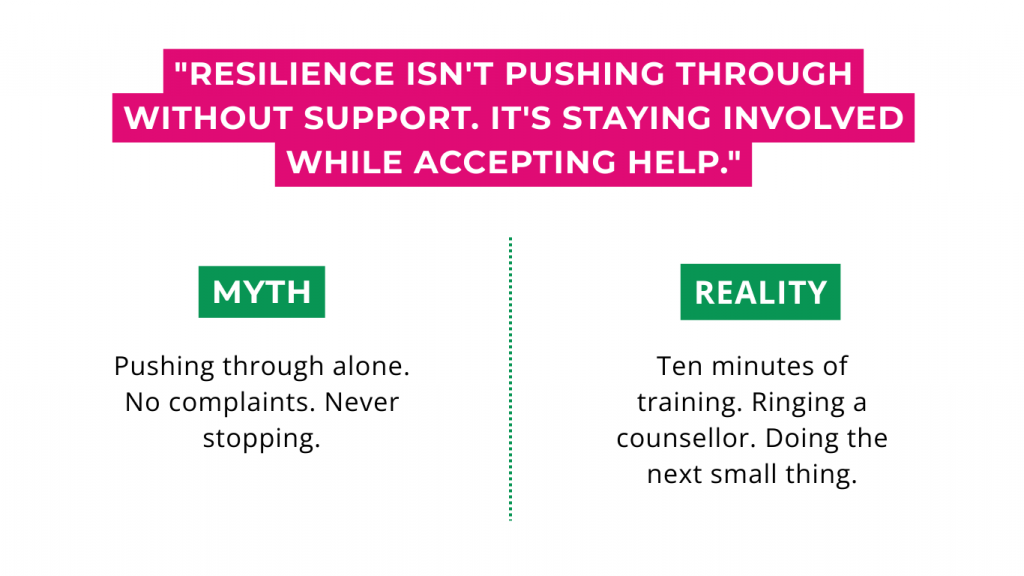
I rang a counsellor. I saw my doctor. I kept training, even if it was ten minutes.
I didn’t keep going because I’m tough. I kept going because staying engaged matters to me.
Resilience isn’t pushing through without support. It’s staying involved while accepting help.
Looking back, that year shaped me. It reminded me that strength isn’t just physical. It’s choosing not to withdraw from your own life when it feels hard.
The Strength Parallel
Building physical strength works much the same way.
Muscle strengthens through stress and recovery. You challenge it. It repairs. It adapts. Then you challenge it again.
Small stress. Recovery. Growth.
Life follows a similar pattern.
Setbacks happen. Illness happens. Seasons change. Energy dips.
The question becomes:
Do you step back permanently?
Or do you keep showing up in smaller, steadier ways?
Resilience isn’t dramatic.
It’s often quiet.
It’s choosing to do the next small thing.

The Confidence Connection
Confidence rarely comes from big wins.
It builds from repeated evidence.
Every time you train when you don’t feel like it.
Every time you return after a setback.
Every time you’re honest about where you are instead of pretending you’re somewhere else.
You build trust in yourself.
And that trust matters.
Because life will continue to ask things of you — physically and emotionally.
When you’ve practised staying engaged, you meet those moments differently.
Not perfectly.
But steadily.

Move Moment
Think about one area where you’ve felt like stepping back recently.
Maybe it’s your training.
Maybe it’s a goal that feels slow.
Maybe it’s something in your personal life that feels heavy.
Pause and ask:
Am I truly unable to continue right now?
Or am I simply tired?
If you genuinely need rest, take it.
But if you’re capable — even in a smaller way — consider doing the next small thing.
One session.
One conversation.
One step forward.
The willingness to keep going isn’t about pushing endlessly.
It’s about staying involved.
And staying involved is one of the ways you protect both your strength and your confidence over time.

PS: Resilience is simpler than we make it.