The Laundry Detergent Moment: When Your Strength Becomes Someone Else’s Responsibility
I noticed something last week that’s been sitting with me.
My mum was buying the small bottles of laundry detergent. The ones that cost more per wash and need replacing more often. When I asked her about it, she said something that stopped me:
“I can’t handle the big bottles anymore. They’re too heavy.”
She’s in her eighties. She’s always been capable. And now the weight of a laundry detergent bottle feels like too much.
This is what I call an “ageing slippery slope” moment — that point where you make a small adjustment that seems perfectly reasonable but signals something bigger happening.
You tell yourself it’s practical. Sensible. Realistic.
But sometimes, it’s the beginning of something gradual.
The Slippery Slope Has a Name
In exercise science, age-related muscle loss is called sarcopenia. It begins earlier than many women realise. It accelerates as you age. And if you don’t challenge your muscles, strength declines piece by piece.
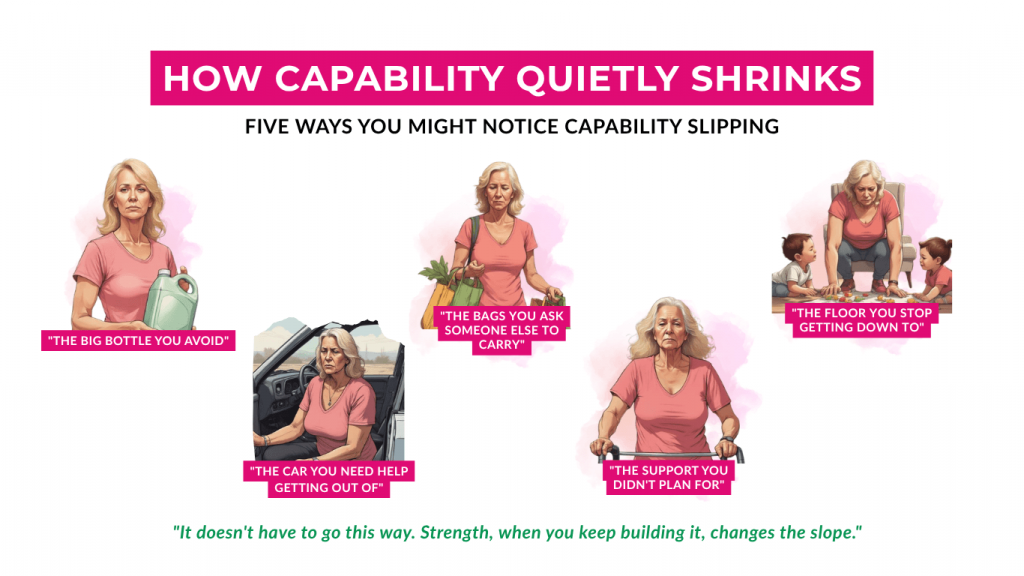
First it’s the detergent bottle.
Then it’s the grocery bags.
Then getting up and down from the floor to play with grandkids.
Then needing help to get out of the car.
Then falling and not being able to get back up.
Each compromise feels reasonable in the moment. But together, they can add up to a life that gradually becomes smaller.
What concerns me is how quickly this gets accepted as “normal ageing.”
“Of course she can’t lift that — she’s 80.”
“Well, what do you expect at her age?”
“That’s just what happens when women get older.”
But muscle loss isn’t inevitable in the way it’s often spoken about.
It happens when muscles stop being challenged.
And muscle responds when it’s trained — even later in life.
What You Accept vs What You Can Influence
I’m not suggesting an 80-year-old woman should be deadlifting 100kg. Ageing does bring change. Joints wear. Recovery takes longer. Things feel different.
But strength? Strength can be maintained. Strength can even be built. Research shows women in their eighties can still increase muscle when they train consistently and appropriately.
The question isn’t just “Can I stay strong?”
It’s “Am I willing to work for it?”
Because buying the smaller detergent bottle is easier than committing to two strength sessions a week. Accepting help with the shopping is easier than training your grip strength. Staying seated is easier than getting up and down from the floor.
Every compromise you make around “getting older” is a choice.
Sometimes it’s the right choice.
But sometimes it’s simply the easier one.

The Confidence Connection
When my mum can’t lift the detergent bottle, it’s not just about the weight.
It’s about capability.
It’s about confidence.
It’s about how a woman sees herself in her own life.
She’s making do. Adapting. Getting by.
But decline doesn’t have to be accepted without question.
Not if strength is something you continue to work for.

Move Moment
Think about one small thing you’ve started compromising on recently.
Something you’ve decided you “can’t” do anymore. Or something you’ve found an easier workaround for.
Pause and ask yourself:
Is this truly beyond me?
Or have I simply stopped challenging myself?
If it’s genuinely not possible right now, that’s okay.
But if it’s something you could rebuild — slowly, consistently — that may be your starting point.
Maybe it’s carrying your own groceries.
Maybe it’s getting up and down from the floor once a day.
Maybe it’s adding a little weight to something familiar.
Small actions. Repeated over time.
Because capability rarely disappears overnight.
It shifts gradually.
And strength — when you continue to build it — helps you stay involved in the life you want to live.
PS. This is how it usually starts. And this is why it matters.