My Arms Wobble. But Can I Still Climb a Tree?
My granddaughter crab walked to the bathroom the other day.
Not because she needed to. Not because something was wrong. I asked her why and she looked at me like the answer was obvious.
“Because I can. And I want to.”
I watched her disappear around the corner and sat there for a second. Can I?
I got down on the floor. And crab walked the entire hallway.
And that, right there, is the whole point of this blog.
Not long ago, a client told me her grandchild had been patting her on the bottom — the way kids do when they think something is funny — and when she asked them to stop, they said, “But Nan, your bum is squishy. Like a squishy toy.”
We both laughed. Because what else do you do?
But later, I thought about what she did with that moment. She didn’t go home and cry about it. She came to training. She started paying attention. She started asking the right question — not why does my body look like this? but what can my body actually do?
That shift is everything.
The Question We Were Taught to Ask
Most of us grew up being told our body’s value was in how it looked. The number on the scales. The size of our jeans. Whether things sat right in your togs.
So when something changes — and things do change as we get older — the first place our brain goes is I’m getting fatter. I’ve let myself go. I look terrible.
I hear it constantly. Women come to me saying they want to lose weight. And I believe them — that’s genuinely what they think they want. But when we dig a little deeper, that’s rarely the real fear. The real fear is that they’re losing ground. That things they used to do easily are getting harder. That their body is quietly changing and they haven’t been paying close enough attention to notice.
The language of “I need to lose weight” is just the only language they were given.
What’s Actually Happening
Here’s the truth, in plain terms.
Your muscle and your fat are two completely different tissues. One does not turn into the other — not ever, not in either direction. What actually happens is two separate things running at the same time.
The muscle gets smaller when you stop giving it a reason to stay. Your body is ruthlessly practical — use it, it stays; ignore it, it heads out the door. At the same time, fat accumulates, and some of it moves into the space the muscle used to occupy. Same spot, different tissue. That’s why the mirror tells such a convincing story. But the story it’s telling you is about appearance. It’s not telling you the part that actually matters.
The part that matters is this — both of those processes respond to the same things. Movement. Strength training. Protein. Showing up consistently. The body isn’t betraying you. It’s just adjusting to what you’ve been asking of it.
Ask less, it gives you less.
Start asking more, and it starts answering.
The research on this runs all the way into people’s eighties and nineties. Your body did not decide to stop responding. It’s waiting for a reason to.
The Right Question
So here’s what I want you to consider.
Instead of standing in front of the mirror asking why do I look like this — what if you asked what can I actually do?
Can you hang out the washing on a windy day and still keep the clothesline steady?
Can you get up off the floor without using your hands or twisting yourself like a contortionist?
Can you walk up a flight of stairs without stopping at the top to catch your breath?
Can you crab walk to the kitchen, bathroom, or any room of your choosing?
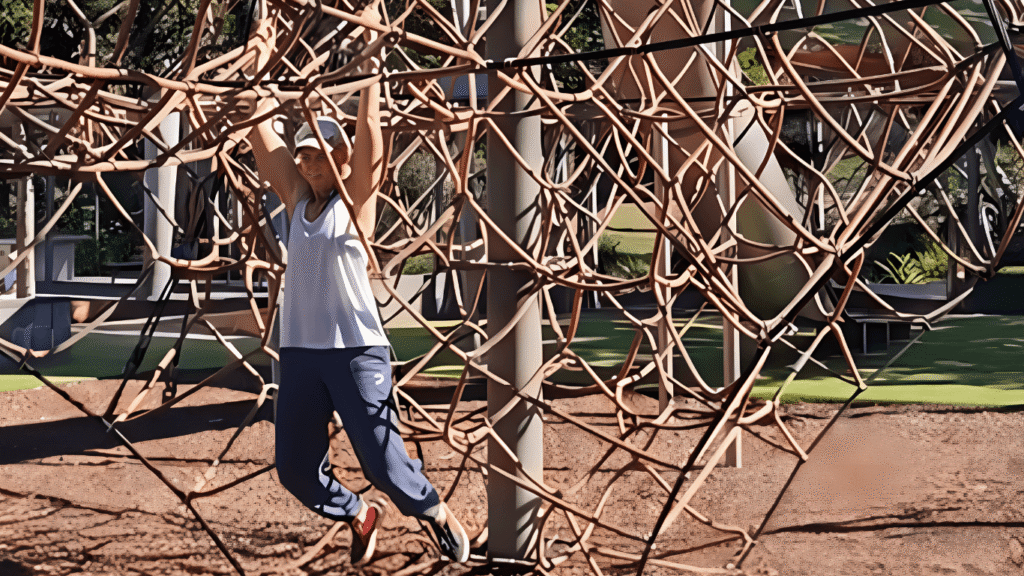
Can you climb a tree with your grandkiddo?
Can you open the jar without using the kitchen gadget?
These are not small questions. These are the questions that tell you whether your body is keeping up with your life — or whether your life is quietly shrinking to fit your body.
And here’s the thing I’ve seen over and over again with the women I work with. When they stop chasing the mirror and start chasing capability, something shifts. They start noticing things. They start paying attention to what their body is telling them. They catch the small changes before they become big ones.
That time with yourself — really paying attention to what your body can and can’t do — is not vanity. It’s information. It’s the most useful thing you can do.
The Wobble Doesn’t Have to Be the Story
Yes, my arms wobble a bit these days. I’m not going to pretend otherwise.
But last week I hung upside down from the monkey bars at the park with my granddaughter. I carried heavy bags of horse feed to the bins and emptied them. I got down on the floor and played and got back up again without a second thought.
The wobble is not the story. What the arms can do is the story.
Your body changed. That’s real. Some of that is age, and some of it — a larger chunk than most people realise — is what you’ve been asking of it. Or stopped asking.
The good news is that the moment you start asking again, your body starts answering.
Not perfectly. Not overnight. But it answers.
So the next time you catch yourself in the mirror and the first thought is about how things look — try redirecting. Ask the better question.
What can I still do?
And then go find out.
The Confidence Connection
Capability is confidence. Not the kind you perform for other people — the kind that lives in your body. The kind that lets you say yes without hesitating. That comes from knowing what you can do, and doing it.
Move Moment
Find your crab walk. Literally — get on the floor and try it. Or find your version. What’s something physical you haven’t done in a while that you used to do easily? Do it today and find out where you’re at. Your body will tell you everything you need to know.