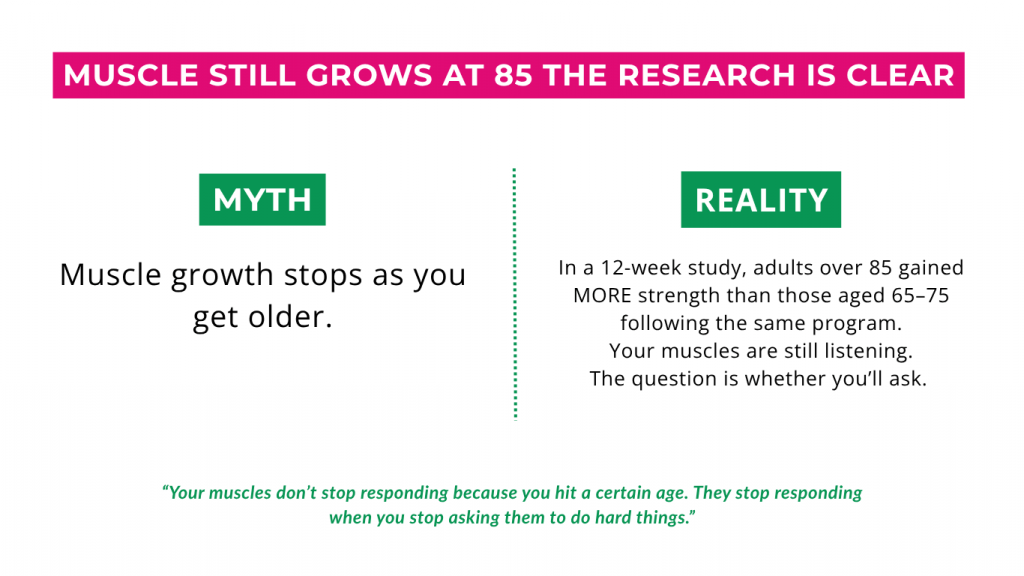
Muscle Still Grows at 85. The Research Is Clear.
Dianne is 80. When she started with me, she couldn’t do up her shoelaces. After a few weeks of early morning workouts, she caught herself wondering why she bothered getting up in the cold and dark. Then she bent down to put on her shoes—and realised. She could do it. Easily. That’s when she stopped asking why and just kept showing up.
Your muscles don’t stop responding because you hit a certain age. They stop responding when you stop asking them to do hard things.
The Science We Need to Talk About
Scientists compared two groups of healthy older adults—those aged 65-75 and those over 85. Both followed the same 12-week strength training program, working out three times per week.
The results? The 65-75 year-olds increased quadriceps muscle size by 10 percent. The 85+ group gained 11 percent. Leg strength jumped 38 percent in the younger group and 46 percent in the older group. Nearly identical improvements.
Your muscle tissue remains responsive because the key mechanisms—protein synthesis, muscle fibre recruitment, neural adaptations—continue to function throughout ageing. Your muscle fibres retain their ability to grow when challenged with progressive resistance. Even at 85. Even beyond.
But we’re not paying attention to the right things.
What We Focus On vs. What Actually Matters
We’re still obsessed with weight loss instead of capability. We’re hiding our arms because we hate the wobbly bits instead of asking ourselves: What can’t I do that I need to be able to do?
Jenny couldn’t get on the floor, let alone get up. After working on the foundations, she could. Then she was climbing ladders to clean out her kitchen cupboards. She’s in her 60s.
Kaye’s husband had a stroke. Suddenly she found herself lifting a wheelchair in and out of the car multiple times a day. She went to the store, bought potting mix, and managed to lift the bags into her car by herself. She’s almost 70.
These women aren’t building muscle for percentages on a scan or numbers on a scale. They’re building capability to do what matters in their lives. To handle what gets thrown at them. To not need help for things they want to do themselves.
The science says you can do something about it. The question is: will you?
The Real Enemy
My personal belief? We know we can do more. But we’re full of excuses – me included.
Don’t get me started on “I don’t have the motivation.” The reality is it’s not a priority and you’re waiting for perfect conditions that don’t exist. And that’s ok, being honest with yourself is a far better option than using “motivation” as your reason.
Some of us—including me—tell ourselves stories. My mum believes “why bother?” Meanwhile, her friend goes to the gym each week. Same age. Different story. Different capability.
You know what you need to do. The gap between knowing and doing is either excuses or priorities.

The Confidence Connection
Here’s what muscle actually does: it gives you autonomy.
It’s not about aesthetics or fitting some ideal. It’s about staying in the game of life. About not shrinking—physically or otherwise—just because, maybe, we’re expected to fade quietly into the background.
It’s about being able to get down on the floor with your grandkids and get back up again without assistance. About carrying your own groceries without waiting for help. About handling what life throws at you—the expected and the unexpected—without having to reorganise your entire world around what you can’t do.
Muscle equals capability to do what matters most in your life. And that capability is still available to you. Your body hasn’t given up on you. The question is whether you’re giving up on it.
Move Moment
Do it right now. Not tomorrow. Not when you feel motivated. Not when conditions are perfect. Right now.
Do 5 walk outs to floor drops. Can’t do that? Do 10 sit-to-stands.
Walk outs to floor drops: Start standing. Walk your hands down toward the floor, bending at the hips and knees as needed. Lower yourself to the ground in a controlled way. Then reverse it—get yourself back up to standing. This teaches your body to control your descent to the ground and get back up again. This is what lets you play with grandchildren, garden, retrieve something from a low cupboard, and—critically—recover if you do fall. This movement protects your independence.
Sit-to-stands: Sit in a chair. Stand up without using your hands. Sit back down with control. Repeat 10 times. This builds the leg strength that gets you in and out of chairs, cars, and toilets without using your hands for assistance. This is what keeps you from needing grab bars, help, or adaptation. This movement protects your dignity.
Both use the exact muscle groups this research proves will still respond—no matter how many candles were on your last birthday cake.
Keep doing something each day to help yourself. Because no one is doing this for you.
Time might be moving on, but your muscles will still respond. The question isn’t whether they can. It’s whether you will.
PS. What can’t you do right now that matters to you? That’s where you start.