How You Walk Matters More Than How Far You Walk
The Redcliffe waterfront fills up early.
Walkers. Runners. Cyclists. Women pushing prams. Older men powering along with purpose. Coming from the farm, where some mornings I see no one at all, it’s a lovely shift. The hellos, the good mornings, the giddays. People out and moving and connected to the world around them.
It’s genuinely good to see.
But here’s what I also see…
At least two out of every three people have something going on with the way they move. Feet rolling inward. Arms pinned to their sides instead of swinging. Eyes glued to the ground. Toes striking first instead of heel to toe. It’s not one or two people — it’s most of them.
And they have no idea.
What’s Really Happening
Gait — the way you walk or run — is a full-body movement pattern. When it’s off, the compensation doesn’t stay local. Feet rolling inward shifts load up through the ankles, knees, hips, and lower back. Walking on your toes without a proper heel strike changes how your entire posterior chain absorbs force. Not swinging your arms affects your spinal rotation and overall movement efficiency.
None of this feels like much on any given morning.
But years of it? That’s a different story.
The body is remarkably good at adapting around dysfunction — right up until it isn’t. Then an injury shows up that seems to come from nowhere. Except it didn’t come from nowhere. It came from thousands of repetitions of a pattern that was slightly off.
Real-Life Anchor
I know this personally.
My ankle injuries have shaped what I can and can’t do when it comes to staying active. Not dramatically — I’m still out there — but there are limitations I carry that trace back to movement patterns I didn’t pay attention to early enough.
I see the same thing in my training sessions. When I take clients through farmers walks — which are essentially a loaded, intentional version of walking — most of them look down. Immediately. Without thinking. It’s the same pattern they carry on the footpath every morning, just now with weight in their hands. What you do without the load is what you do with it.
Gait doesn’t lie.
The Shift
This isn’t about being perfect. I’m not. You’re probably not either.
Most of us have some variation in our movement that reflects old injuries, old habits, or simply never having been taught any differently. That’s not a character flaw — it’s just how life works.
The question isn’t are you perfect — because none of us are.
The question is: are you paying attention?
Because the people I see out there every morning doing the work — I want them to still be doing it in ten years. And the difference between that happening and not often comes down to whether small patterns get noticed before they become big problems.
If something feels off — a knee that niggles after your walk, a hip that grumbles, an ankle that never quite feels right — it’s worth getting your gait properly assessed. A physio or exercise professional can spot things you simply can’t see from the inside. It doesn’t need to be a big deal. One appointment can tell you a lot.
It’s worth a look.

The Confidence Connection
Here’s the thing about movement quality that doesn’t get talked about enough: it’s not just about injury prevention. It’s about confidence.
When you move well — when your body feels reliable and responsive — you do more. You walk further. You try more. You don’t second-guess whether the terrain is too uneven, or whether you should take the lift instead of the stairs.
When your movement patterns are quietly working against you, confidence erodes gradually. You start avoiding things without consciously realising why. You pull back. You play it safe.
Paying attention to how you move — and doing something about it — is one of the most direct paths to staying confident in your body as you age. Not the gym-selfie kind of confidence. The I trust my body to carry me kind.
That’s what matters.

Move Moment
Next time you go for a walk, choose one thing to notice about how you move.
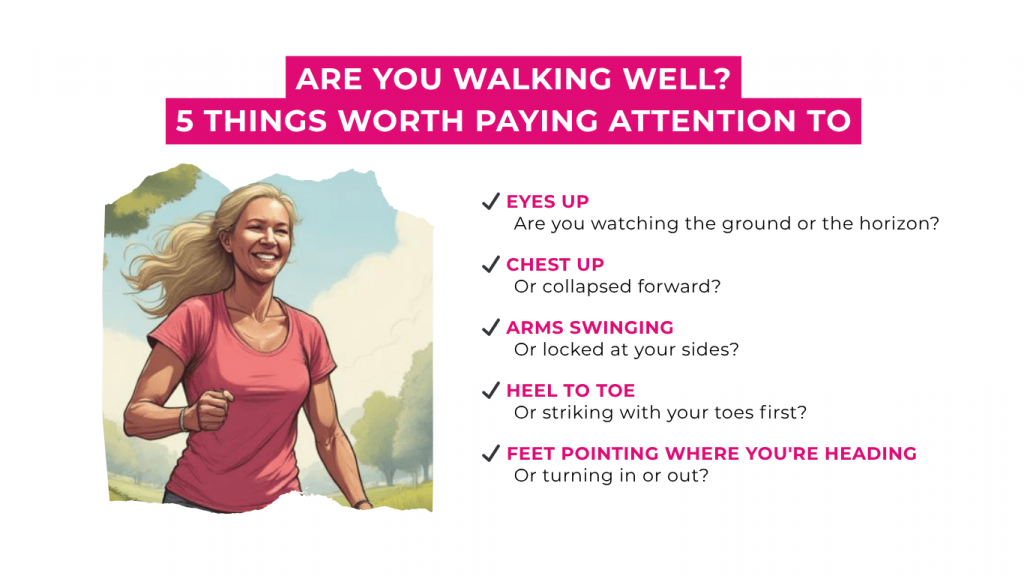
Are you looking down? Lift your gaze to the horizon — that one shift changes your head position, shoulder mechanics, and heel strike. Are your arms swinging? Let them. Are you rolling inward at the foot? Try to feel the outside edge of your foot making contact.
You don’t need to fix everything at once. Just notice one thing.
Awareness always comes before change.

PS. Five things worth checking next time you head out the door.