What Happens in the Minute After You Stop Is Where Your Fitness Lives
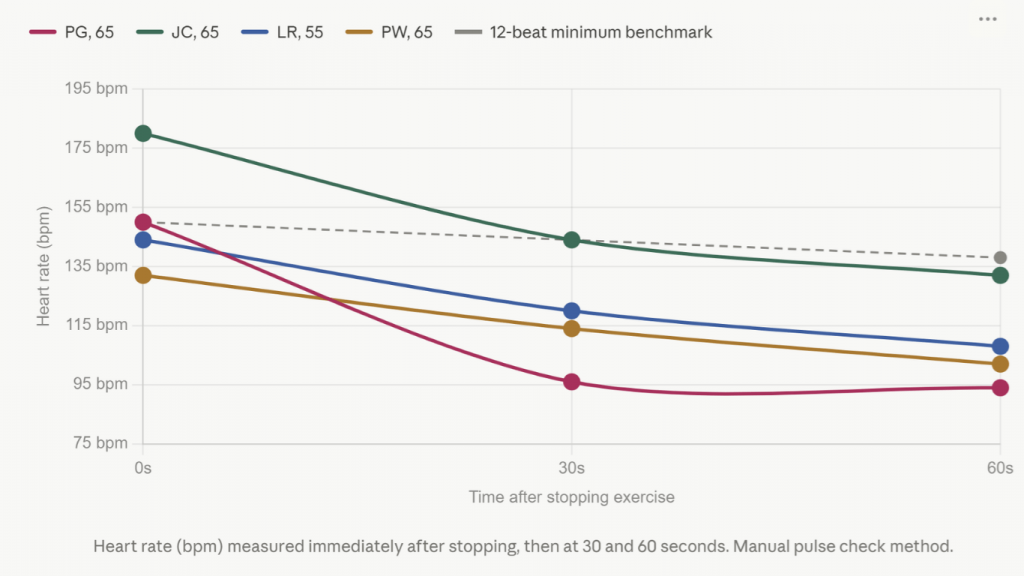
I finished a 20-minute HIIT session — 20 seconds all-out, 30 seconds active recovery, repeat — and checked my heart rate immediately after. It had hit 150 bpm. Thirty seconds later it was down to 96. Sixty seconds after that, 84.
That’s a 56-beat drop in 60 seconds.
I’m 65. I didn’t start strength training until my 40s. I lost ground in my 50s — hormones, injuries, life getting complicated. I’ve spent my 60s deliberately rebuilding.
Those numbers are what that looks like on the inside.
What’s Really Happening
Heart rate recovery — how fast your heart rate drops after you stop exercising — is one of the most reliable indicators of cardiovascular fitness available. The faster it drops, the more efficiently your autonomic nervous system is working. That’s your body’s ability to shift from work mode to rest mode, and it’s trainable.
The standard minimum benchmark is a drop of 12 beats in the first 60 seconds after stopping. Fit, active women typically see much more than that.
But here’s what most people miss: it’s not just the number itself that matters. It’s the trend. What’s happening to your recovery over weeks and months of consistent training? That’s where the real story is.
We measure heart rate manually after every HIIT session — fingers on the wrist or neck, counting beats for 10 seconds, multiplying by 6. Simple, reliable, and it removes the variability that comes with fitness trackers. There’s a natural margin of a beat or two either way with manual counting, and that’s fine. We’re not chasing a perfect number on any single day. We’re watching the direction of travel over time.
Real-Life Anchor
Four women. All training consistently. Mid-50s to mid-60s. Here’s what the data is showing.
JC, mid 60s. JC’s peak heart rate sits consistently around 180 bpm — she pushes hard every session. But it’s her recovery that tells the real story. In August 2025 her heart rate dropped 36 beats in 60 seconds. By October it was 42 beats. By February 2026 it was 48 beats.
A 12-beat improvement in 60-second recovery over six months. Her heart is getting more efficient — she can push just as hard and bounce back faster.
PW, mid 60s. PW’s story is different — and equally compelling. Her peak heart rate has dropped from 156 in December 2025 to 132 in April 2026. This doesn’t mean she’s working less hard. It means her cardiovascular system is becoming more efficient, needing less effort to do the same work. In April, she dropped 30 beats in 60 seconds from that 132 peak.
A more efficient engine, getting fitter quietly in the background.
LR, mid 50s. LR is pushing harder over time — her peak has climbed from 144 to 162 over 18 months of consistent training. What’s striking is that her 30-second recovery has held steady even as her intensity has increased. In March 2026, she dropped 36 beats in 60 seconds from a peak of 144.
Her body is rising to meet the increasing demand. That’s capacity being built.
PG — me, 65. 56 beats in 60 seconds. After everything — the injuries, the hormonal shifts, the years of rebuilding. That number is the receipt for the work.
The Shift
These four women are not exceptional. They are consistent.
None of us have perfect training histories. None of us have avoided the complications that come with being a woman in midlife — the hormonal shifts, the injuries, the seasons of life that made training harder to prioritise. What we have in common is that we kept coming back and we kept pushing into genuine high-intensity work, not just staying comfortable.
And none of us enjoy this training. Not me, not PW, not JC, not LR. We do it because we understand what it’s doing to our cardiovascular system and what that means for the years ahead. That’s a different motivation to enjoyment — and in some ways a more durable one. You don’t need to love it. You need to understand why it matters.
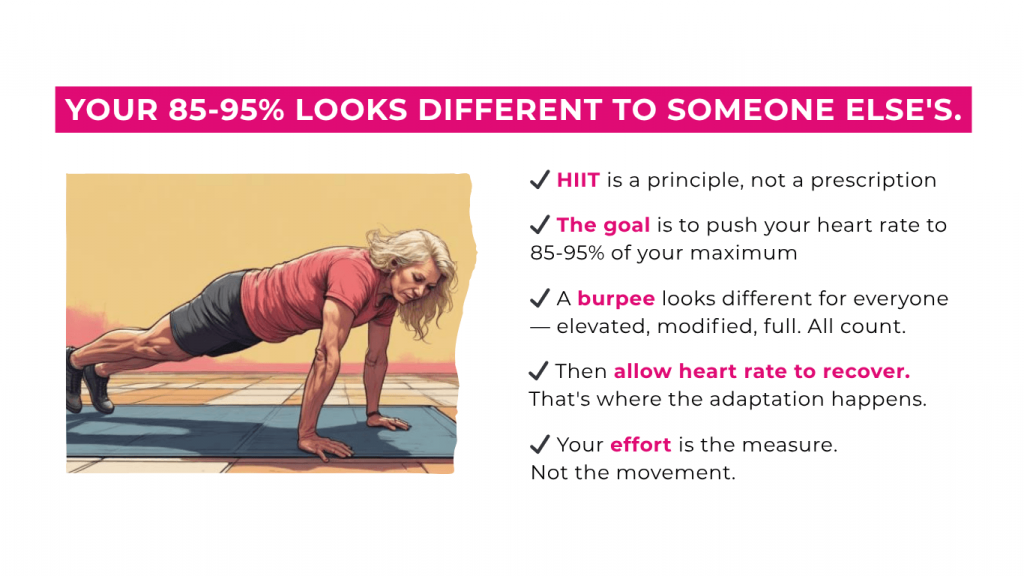
Heart rate recovery is not a gift. It is an adaptation. Your cardiovascular system responds to the stimulus you give it — but only if the stimulus is actually demanding enough to require adaptation. That means real effort. Short bursts of genuine high-intensity work, not a gentle cruise that keeps your heart rate in a comfortable zone.
Your body is capable of more than you think. But it will only show you that if you ask it the question.

The Confidence Connection
There is something quietly powerful about having data on your own body.
Not a feeling. Not a hope. Actual numbers, tracked over time, showing a direction of travel.
When JC sees her 60-second recovery improve by 12 beats over six months, that’s not abstract. That’s proof. When PW watches her peak heart rate drop as her efficiency improves, she knows something real is changing inside her. When LR sees her body keeping pace with increasing intensity, she has evidence that she is getting stronger.
This is a different kind of confidence to motivation or positive thinking. It’s the kind that comes from measurement. From showing up, doing the work, and letting the numbers tell you what’s happening.
You can’t fake a heart rate recovery. You can’t wish it into improvement. You train it — and it responds.

Move Moment
After your next walk or any bout of exercise that gets you breathing harder, stop and check your pulse immediately. Fingers on your wrist or neck. Count beats for 10 seconds. Multiply by 6. That’s your heart rate.
Wait 60 seconds. Check again.
Write both numbers down somewhere. Date it.
Do it again next time. And the time after that.
You’re not chasing a number. You’re starting to watch your trend. And your trend will tell you everything.

PS. That little red heart is trying to tell you something. Here’s how to read it.