What Your Toenails Know About Your Fitness
Ruth said this to me recently, and it stopped me in my tracks.
“My test is cutting and painting my toenails.”
We’d been talking about how to know if you’re maintaining your fitness or starting to decline. I’d mentioned some of the warning signs – sitting to put shoes on, using the trolley for just a few items, avoiding the floor, the list goes on…
And Ruth, in her wonderfully practical way, said: “I know exactly where I’m at. My test is cutting and painting my toenails.”
Brilliant.
Because here’s what Ruth understands that most of us can miss: the real tests of your fitness aren’t happening at the gym. They’re happening in your everyday life. And if you’re not paying attention to them, you’ll miss the early signs that things are changing.
The Tests We Don’t Think About
When most people think about fitness tests, they think about gym stuff. How much can you lift? How long can you plank? How fast can you run?
But those aren’t the tests that matter for how you actually live your life.
The real tests are the ordinary things you do without thinking about them… until suddenly you can’t do them as easily anymore.
Ruth’s toenail test? It’s not about vanity. It’s about capability.
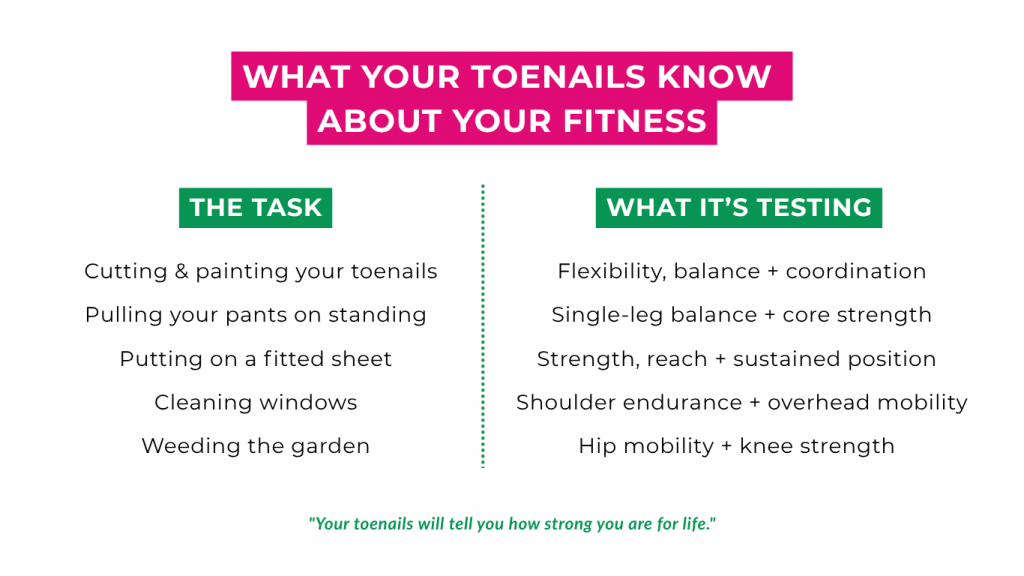
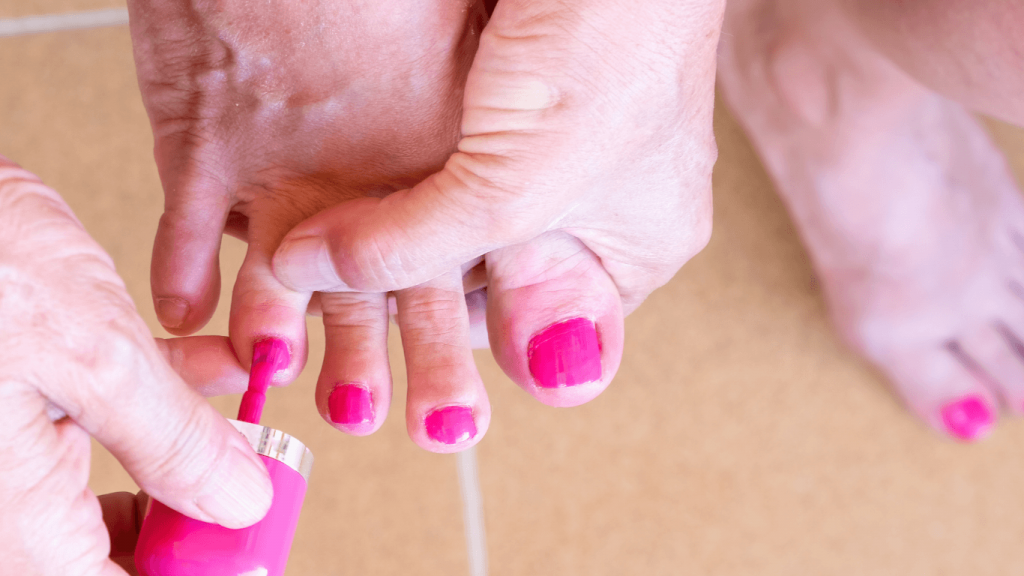
Think about what cutting and painting your toenails actually requires: You need to sit comfortably for a sustained period. You need hip flexibility to bring your foot up. You need shoulder mobility to reach down. You need hand strength and coordination for the actual cutting and painting. You need balance to hold the position without wobbling.
It’s a full-body functional fitness test hiding in a pretty task.
And here’s what makes it brilliant: Ruth does this regularly enough to know if it’s getting easier or harder. She’s not hoping she’s maintaining her fitness. She knows.
Your Life Is Full of These Tests
Once you start looking for them, you see them everywhere.
Some tests you do every single day. Like pulling your pants on while standing. Sounds simple, right? But it requires single-leg balance and core strength. The day you start sitting down to do this? That’s information about your body.
Some tests happen weekly. Putting a fitted sheet on your bed – especially those far corners that require you to lift the mattress while stretching across the bed. That’s testing your strength, your reach, your ability to sustain an awkward position. Or getting down to weed the garden and staying down there for 20 minutes without your knees screaming at you to stop.
Kristine mentioned one I loved: cleaning windows. Arms overhead for sustained periods, reaching, holding the position. It looks like housework. It’s actually testing your shoulder endurance and overhead mobility.
Then there are what I call “the pretty things” – the personal care tasks that aren’t just functional, they’re about how you feel about yourself. Shaving your legs in the shower while balancing on one leg. Doing up a necklace clasp behind your neck. These aren’t just physical tests. They’re about maintaining practical function in the small acts that make you feel put-together.
And the seasonal ones? Decorating for Christmas. Getting boxes down from storage. Reaching high to hang decorations. These come around once a year, and each time they’re a snapshot of where you’re at compared to last year.
Why These Tests Matter More Than You Think
Here’s what I’ve learned: you can’t improve what you don’t measure.
And most of us aren’t measuring anything. We’re just hoping we’re maintaining our fitness. Hoping we’re not declining. Hoping we’ll be fine.
But hope isn’t a strategy.
Ruth’s toenail test works because she’s paying attention. She knows if it’s getting easier (flexibility improving, balance more solid) or harder (struggling to reach, wobbling more, needing to rest halfway through).
That’s not hope. That’s data.
And data is what lets you do something about it before it becomes a real problem.
When I noticed Paul sitting down to pull his pants on, I said, ‘Can you stand to do this?’ His response was of course… then keep standing! I don’t just think “oh well, getting older.” I think “that’s new. That’s information. What can I do about it?”
When the fitted sheet feels harder to wrestle onto the bed this month than it did three months ago, that’s telling me something about my strength and mobility. I can ignore it, or I can pay attention and actually do something.
The tests are everywhere. We’re just not treating them like tests.

The Confidence Connection
Here’s where this really matters: confidence doesn’t come from hoping you can do something. It comes from knowing you can.
Ruth is confident in her body because she has proof. Every time she does her toenails, she’s proving to herself that she still has the flexibility, balance, coordination, and strength to take care of herself.
That’s not abstract. That’s concrete evidence that her body is capable.
When you test yourself on the things that matter in your real life – and you see improvement or at least maintenance – that builds genuine confidence. Not the fake “positive thinking” kind. The real “I know I can do this because I just did it” kind.
But when you avoid the tests? When you stop paying attention? When you don’t notice that you’re sitting down to put on pants now, or struggling with the fitted sheet, or skipping the toenail painting because it’s gotten too hard?
That’s when confidence erodes. Because somewhere in the back of your mind, you know you’re avoiding something. You know you’re not sure you could do it anymore. And that uncertainty chips away at your confidence in your body… and in yourself.
The beautiful thing about treating these everyday tasks as tests? You get regular feedback. Monthly with the toenails. Weekly with the gardening. Daily with the pants.
You’re not waiting for an annual check-up or some arbitrary fitness assessment. You’re getting real-time information about how your body is functioning in the ways that actually matter to your life.
And when you’re paying attention to that information, you can do something about it. You can get stronger. You can improve your flexibility. You can work on your balance.
But first, you have to know where you’re at. You have to have your tests.
What I Notice Now
These days, I pay attention to my own tests.
I notice when something that used to be automatic now requires thought. When I have to brace myself against something I didn’t used to need support for. When I avoid a task not because I don’t have time, but because I’m not sure it’ll go well.
That’s all information.
And once you start noticing, you can’t un-notice. You see the tests everywhere. You see the opportunities to maintain (or regain) capability in the ordinary moments of your day.
I’m not obsessive about it. I’m not turning every task into a performance evaluation. But I am paying attention. Because Ruth’s right – these everyday tasks tell you everything you need to know about your fitness.
The gym tests will tell you how strong you are in the gym. But your toenails? Your toenails will tell you how strong you are for life.

Move Moment
This week, pick your test.
Choose one ordinary task that you do regularly – daily, weekly, or monthly. Something that requires a bit of effort but isn’t impossible. Maybe it’s Ruth’s toenail test. Maybe it’s pulling pants on standing. Maybe it’s the fitted sheet, or the garden weeding, or the necklace clasp.
Do it mindfully. Pay attention to what it actually requires. Notice if it feels easy, challenging, or somewhere in between.
Then mark it down. Mental note, phone note, whatever works. Just register where you’re at right now.
Because here’s the thing: you can’t know if you’re improving unless you know where you started.
Three months from now, test yourself again. Same task. Notice if it’s gotten easier or harder.
That’s not hope. That’s proof. And proof builds confidence.
Your toenails know the truth. Time to start listening.
PS. Your everyday life is already testing you. Here’s what it’s measuring.