Why Nothing Feels Exciting Anymore (And What Your Hormones Have to Do With It)
Recognition
There are days when I rely entirely on my routine to get me through.
Not inspiration. Not excitement. Not passion. Just the quiet discipline of doing what I know I need to do — even when nothing inside me is cheering me on.
And honestly? Some days I wonder why I feel like this.
Because I remember being different. I used to be the energiser bunny. Enthralled in life. Up early, going hard, genuinely excited about what the day held. That version of me didn’t need convincing to show up — she just did.
So when that feeling dims, it’s disorienting. You don’t feel sad exactly. You don’t feel broken. You just feel… flat. (Or the technical term — blah.)
Like someone turned the volume down on life and you can’t quite find the dial.
If you know that feeling, I want you to know something important.
It’s not you. It’s your hormones. And there’s a reason.
What’s Really Happening
You’ve probably heard of dopamine — the brain’s so-called “feel-good” chemical. But it’s more than that. Dopamine drives motivation, anticipation, pleasure, and the feeling that life is worth leaning into.
Here’s what most people don’t tell you: estrogen directly supports your dopamine pathways.
When estrogen is present in healthy amounts, it helps your brain produce and respond to dopamine more effectively. You feel engaged. Curious. Energised. Like yourself.
After menopause, estrogen drops significantly. And with it, so can your natural dopamine activity.
This is why so many women in our stage of life describe a feeling that’s hard to name. It’s not quite depression. It’s not burnout. It’s more like the joy has gone a little quiet. The things that used to light you up don’t quite do it the same way. Getting started on anything feels heavier than it used to.
This isn’t a personality change. It isn’t weakness. It isn’t ingratitude.
It’s biology — and once you understand it, you can start working with it instead of wondering what’s wrong with you.
Real-Life Anchor
On the days when I have nothing — no motivation, no excitement, no sense of momentum — my routine carries me.
I move my body anyway. I follow the structure I’ve built. I do the things I know matter, even when they don’t feel like they matter right now.
And here’s what I’ve learned from 20-plus years of working with women and living this myself: movement is one of the most powerful natural triggers for dopamine production.
When you move — a walk, chasing the grandkiddos around the backyard, a workout that feels like hard work even on a slower day — your brain responds. Dopamine is released. The grey lifts a little.
It doesn’t always feel transformative in the moment. Sometimes it just feels like you did the thing. But over time, consistent movement rebuilds the neural pathways that support motivation and mood. You’re not just getting stronger. You’re literally giving your brain what it needs to feel like itself again.
That’s not a small thing.
The Shift
Movement is the cornerstone — but it’s not the only lever you have.
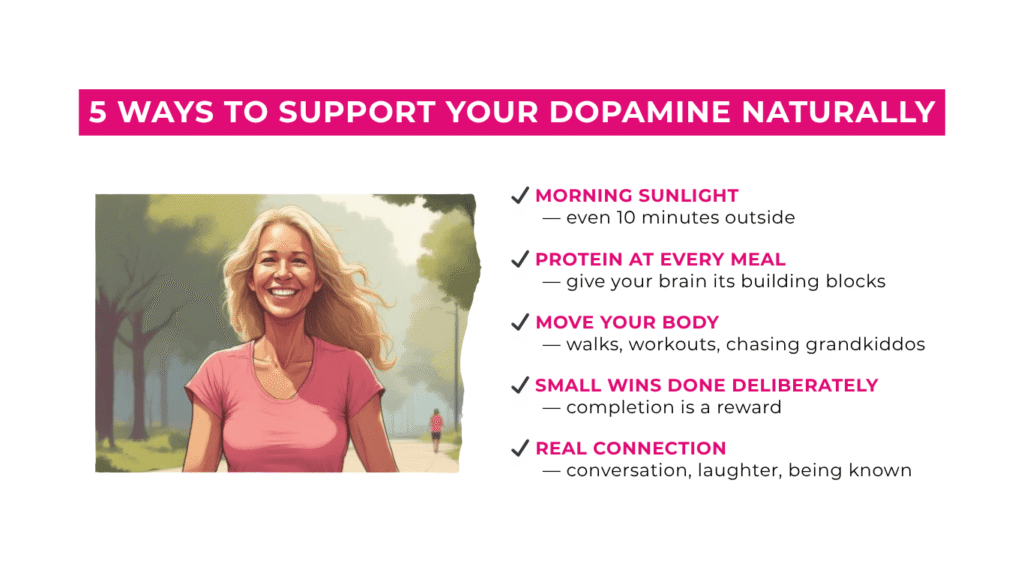
Sunlight in the morning. Getting outside early, even for ten minutes, supports healthy dopamine and serotonin patterns throughout the day. Simple. Free. Wildly underused.
Protein at every meal. Dopamine is made from amino acids — the building blocks of protein. If you’re undereating or skimping on protein, you’re not giving your brain the raw materials it needs. Breakfast especially.
Small wins, done deliberately. Dopamine responds to completion. Ticking something off. Finishing a workout. Making the meal. Build your days around actions you can actually complete, and let your brain do its job.
Less noise, more presence. When we’re constantly consuming — scrolling, back-to-back input, never quite still — we override the brain’s natural rhythm. Quiet isn’t a luxury. It’s a necessity.
Real connection. A proper conversation. Laughing with someone you love. Being known. These are deeply dopaminergic experiences, and we underestimate how much they matter as life gets quieter.
None of this requires a program. None of it requires perfect conditions. It just requires a decision to keep choosing the things that support how you want to feel.

The Confidence Connection
Here’s what I want you to sit with.
The days you show up without wanting to — the mornings you move your body before your brain agrees, the workouts you finish despite starting flat — those aren’t wasted days.
Those are the days that build the kind of trust most women never talk about.
Not trust in a program. Not trust in a coach. Trust in yourself — in your own capacity to do the hard thing when nothing in you wants to.
That’s not gym-selfie confidence. That’s the real kind. The kind that carries you through the hard seasons, that shows up at the doctor when something doesn’t feel right, that says I’m still worth investing in even when everything feels a bit grey.
The energiser bunny might feel far away some days.
She hasn’t left. She’s in every walk you take without wanting to start. Every morning you get up anyway. Every small choice that says you’re still here, still in it, still ageing with intention.

Move Moment
A small action you can take right now that supports how you want to age.
Step outside. No phone. Even five minutes of natural light and movement shifts your brain chemistry in a way that sitting with the feeling cannot. Your dopamine pathways don’t need a perfect plan — they need a signal. Give them one.
PS. Your brain wants to feel good — here's what it actually needs.