No Thank You (And Why It's So Hard to Say It)
We had an end-of-year gathering recently for the women in Brisbane. I’d brought along two different gift options – Cookie Haircare and Bold Health, both Australian products I absolutely love.
But before anyone took anything, I explained the products and why I loved them and then said something that made a few people pause:
“Please only take it if you’ll actually use it.”
Not “take whatever you want.” Not “help yourself.”
Only take it if you’ll use it.
Because here’s what I know: I hate getting something I have no use for. I hate the thought of someone spending money on something that’s going to sit in a drawer, never opened, gathering dust and guilt.
But as soon as I said it, I wondered: Am I being ungrateful? Should I just be happy someone thought of me?
And then I realised: No. That’s the old programming talking. The one that says women should accept everything graciously, even when it doesn’t serve us.
Why ‘No Thank You’ Is So Hard
Let’s be honest: saying “no thank you” is tough for most women.
Especially women of my generation. We were raised to be gracious. Grateful. Accommodating. To accept gifts with a smile even if we’ll never use them. To say yes when we mean no. To prioritise other people’s feelings over practical reality.
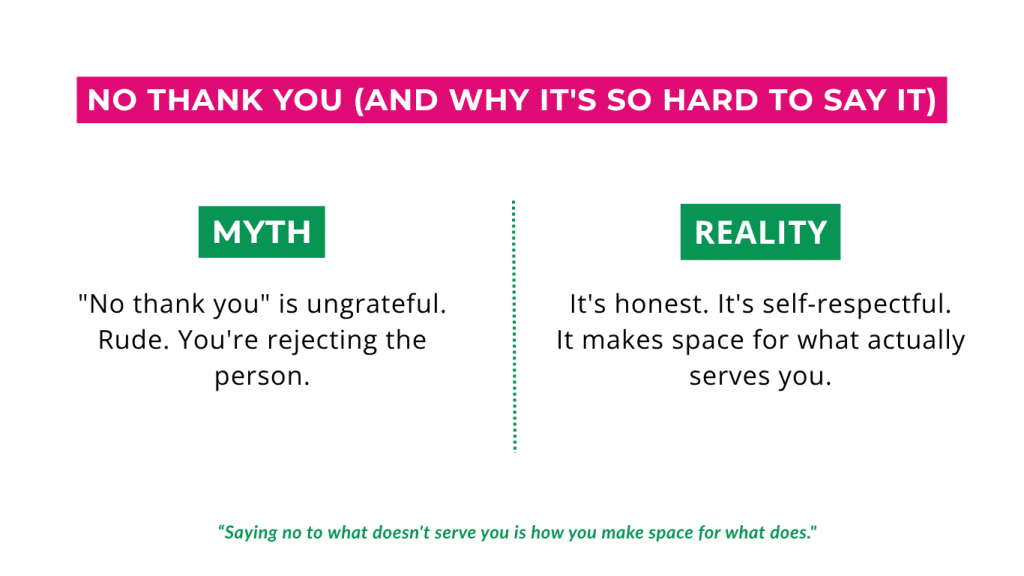
Saying “no thank you” feels ungrateful. Rude. Difficult. Like we’re rejecting the person, not just the gift.
So we say yes. We accept things we don’t want. We take gifts we won’t use. We smile and say thank you and then go home and wonder where we’re going to put this thing we never asked for and will never need.
And then – here’s the kicker – we feel guilty about not using it.
The gift sits there. A reminder that someone was thinking of us. A reminder that we should be grateful. A reminder that we’re somehow failing because we’re not using this thing we never wanted in the first place.
It’s exhausting.
The Cost of Always Saying Yes
Look around your house. I bet you can find evidence everywhere.
Drawers full of unused gifts. Beauty products you’ve never opened. Kitchen gadgets still in the box. Clothing that doesn’t fit your style but someone gave it to you so you kept it.
All accumulated out of politeness. All carrying a little weight of guilt because you’re not using them.
And it’s not just physical gifts.
It’s advice you didn’t ask for but felt obligated to follow. Programs you signed up for because someone recommended them, even though you knew they wouldn’t fit your life. Equipment you bought because it worked for someone else, even though you had no intention of using it.
Cupboards full of fitness gear gathering dust. Yoga mats that never got unrolled. Resistance bands still in the package. That foam roller you used once.
We collect things out of politeness. Out of hope. Out of the inability to say “no thank you, that’s not for me.”
And then we carry the guilt of not using them.
The cost isn’t just the money or the space. It’s the mental load. The constant reminder that you’re not doing the thing, using the thing, being the person who would use the thing.
All because saying “no thank you” felt too hard.
This Shows Up Everywhere in Fitness
I see this pattern constantly with fitness and health.
Women sign up for programs that don’t fit their life because saying “this isn’t right for me” feels like admitting failure.
They follow advice that doesn’t serve them because saying “I’m going to do it differently” feels rebellious.
They buy equipment they’ll never use because saying “I don’t actually want that” feels ungrateful when someone’s trying to help.
They keep doing workouts they hate because saying “this isn’t working for me” feels like giving up.
And all of it – all of it – stems from the same source: the inability to say “no thank you.”
Not “I can’t.” Not “I’m not capable.” Not “I’m failing.”
Just: “No thank you. That’s not for me.”
Simple words. Incredibly hard to say.
But here’s what I’ve learned: saying “no thank you” to what doesn’t serve you is how you make space for what does.
That program that doesn’t fit your schedule? Saying no to it means you can find the approach that actually works for your life.
That advice that doesn’t resonate? Declining it means you can trust your own instincts about your body.
That equipment you’ll never use? Not buying it means you’re being honest about what you’ll actually do, not what you think you should do.
“No thank you” isn’t ungrateful. It’s honest. It’s self-aware. It’s practical.
And it’s essential if you want to build a fitness approach that actually serves you rather than one built on accumulated “shoulds” from other people.
What ‘No Thank You’ Actually Mean
Here’s what I want you to understand: saying “no thank you” isn’t ungrateful.
It’s respectful. To yourself AND to the giver.
When you take something you won’t use, what happens? It sits unused. Wasted. The giver’s money and thought went into something that serves no purpose.
But when you’re honest – “Thank you, but I won’t use this” – someone else who will actually use it can have it. The gift serves its purpose. Nothing is wasted.
That’s not ungrateful. That’s practical.
And it’s self-respectful. Because you’re being honest about who you are and what serves you. You’re not pretending to be someone you’re not. You’re not accumulating things out of obligation.
You’re making space for what actually matters to you.
At that Brisbane gathering, some women took the Cookie Haircare. Some took the Bold Health Creatine. Some took neither because they had different needs.
And you know what? That was perfect. Because the gifts went to people who would actually use them. Nothing was wasted. Nobody went home with something they’d feel guilty about not using.
That’s what “please only take it if you’ll use it” accomplishes. It gives everyone permission to be honest. To know themselves well enough to know what serves them. To have the confidence to act on that knowledge.
It’s a small thing – a gift at a gathering. But the principle applies everywhere.

The Confidence Connection
Learning to say “no thank you” is a muscle. And like any muscle, it gets stronger with practice.
The first time you decline a gift, it feels awkward. Uncomfortable. Like you’re doing something wrong.
But the second time? Slightly easier. The tenth time? It becomes natural.
And here’s what happens as that muscle gets stronger: you start trusting yourself.
You trust that you know what serves you. You trust that you can be honest about your needs. You trust that saying no to what doesn’t fit makes space for what does.
That’s confidence. Not the fake “positive thinking” kind. The real “I know myself and I can act on that knowledge” kind.
This is what Ageless Confidence looks like in practice. It’s not about pretending you’re younger than you are. It’s not about having it all together.
It’s about knowing yourself well enough to know what serves you. And having the confidence to act on that knowledge – even when it means saying “no thank you.”
Even when it feels uncomfortable. Even when you were raised to always say yes. Even when you worry about seeming ungrateful.
Because here’s the truth: you can’t build a life that serves you – including a fitness approach that actually works – if you can’t say no to what doesn’t fit.
Every time you say yes to something that doesn’t serve you, you’re saying no to something that might.
Every time you accept advice you won’t follow, you’re drowning out your own instincts.
Every time you take equipment you won’t use, you’re reinforcing the idea that you don’t know yourself well enough to make good choices.
But when you practice saying “no thank you”? You’re building the muscle of self-knowledge. You’re strengthening your ability to trust yourself. You’re creating space for what actually serves you.
That’s how confidence builds. Not through big dramatic moments. Through small, consistent choices to honour what you know about yourself.
What I Notice Now
These days, I pay attention to where I’m saying yes when I mean no.
I notice when I’m about to accept something out of politeness rather than genuine interest. When I’m considering advice that doesn’t resonate just because someone offered it. When I’m tempted to buy something I probably won’t use just because it worked for someone else.
And I practice. “No thank you.” “That’s not for me.” “I appreciate the thought, but I won’t use it.”
It’s still not always easy. That old programming runs deep. But it gets easier every time.
And what I’ve found is this: the more I practice saying no to what doesn’t serve me, the clearer I get about what does.
The more I decline programs that don’t fit my life, the easier it is to build an approach that does.
The more I’m honest about equipment I won’t use, the more I invest in what I actually need.
The more I trust my own instincts about my body, the less I’m swayed by every piece of advice that comes my way.
“No thank you” creates space. For clarity. For what actually serves you. For confidence in your own judgment.
It’s a small phrase. But it’s powerful.

Move Moment
This week, practice saying “no thank you.“
Maybe it’s to a gift you don’t need. Maybe it’s to advice that doesn’t resonate. Maybe it’s to a program that doesn’t fit your life. Maybe it’s to equipment you know you won’t use.
Start small. Start where it feels manageable. But practice.
Notice how hard it is. Notice the discomfort. Notice the old programming that says you should say yes even when you mean no.
And say it anyway: “No thank you.”
You don’t have to explain. You don’t have to justify. You don’t have to make excuses.
Just: “No thank you. That’s not for me.”
Then notice what happens. The world doesn’t end. People don’t hate you. You’re not ungrateful or difficult or wrong.
You’re just honest. About what serves you and what doesn’t.
That’s the muscle we’re building. Self-knowledge. Self-trust. The confidence to act on what you know about yourself.
It starts with two words: No thank you.
Practice them. Get comfortable with them. Build that muscle.
Because saying no to what doesn’t serve you is how you make space for what does.
PS. Two words. Here's why they matter.